8 reasons businesses love Social Media, for good or not so good reason

Why do businesses love social media? I have come across many executives…


Why do businesses love social media? I have come across many executives…
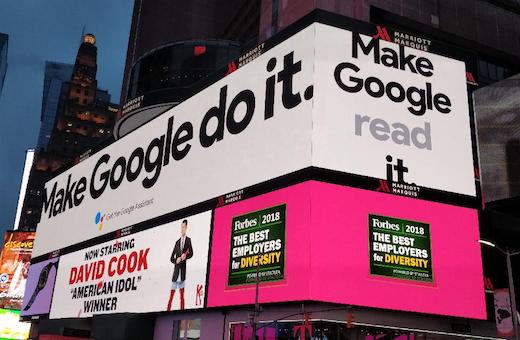
Managing one's online reputation has become a must. It is absolutely unthinkable for anyone who wants to make a professional appointment to leave a photograph on one's facebook profile in which he or she is holding a glass of champagne and assuming weird poses (and God knows I came across quite a few counter examples). Many chances are that the person with whom you are about to have an appointment has just gone straight to ’Google’ your name on the Internet. This is what is called online reputation (or online identity) management (abbreviated ORM), that is to say your image as it is showing online through Internet and social media exposure.

When innovating wrong questions are the right questions. On March 4th, 2009,…

Catherine Hearn – a seasoned expert at Heidrick & Struggles, an exec search…
The blog Council is an association in charge of promoting social media usage by and for the benefit of so-called "big logos". Among the members one will find corporations like GM, Wells Fargo, Procter & Gamble, Kmart and of course Orange Business Services (proudly represented by yours truly).
The council is not just in charge of promoting the usage of social media in the enterprise world. It is of course a - very private - club enabling heads of Internet from major companies around the world to get together and exchange tips and ideas. But the council has also decided to turn itself into a publisher in order to let its members share their vision of the ROI of corporate blogging. Calls for papers were issued by the council late September 2008, and members sent their contributions by October 13 as planned. All contributions will be combined and put together into a collective book which will be published by the council. Much more will be said about that book during the blog Council conference which is planned for the end of October in San Jose.
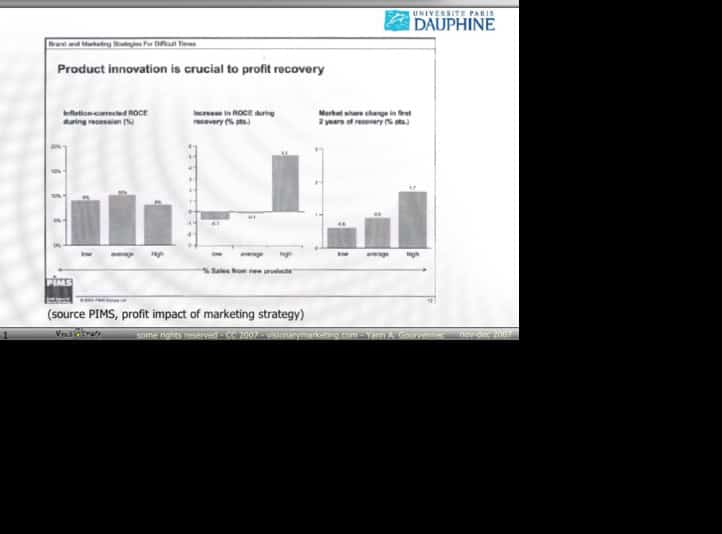
Business week has a very brief story - relayed by innovation tools on their site - on why businesses should go on investing in innovation. Atkins argues that companies have to go on investing in innovation in order to dominate in the next decade. He is right, but unfortunately doesn't explain why?

Corporate strategy is the responsibility of the Board and mainly of the…
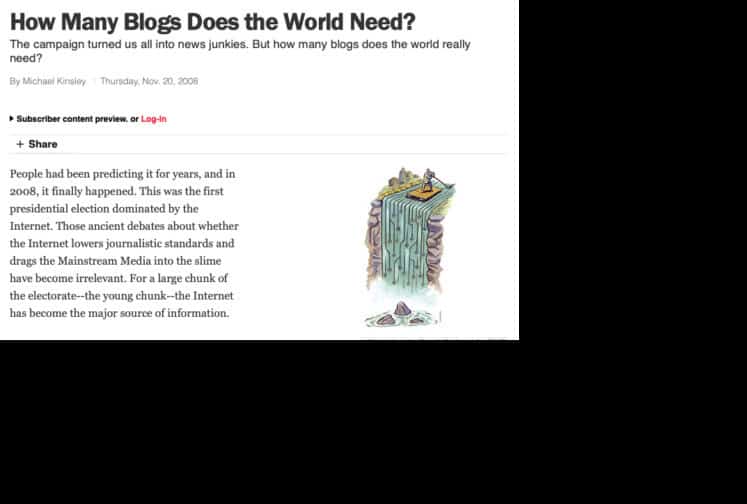
Poor is the substance, alas! and yet I've read all the books(1) was Stephane Mallarme's introduction to "Brise Marine" a cryptic yet exalted poem in which the author was venting his Baudelairian 'spleen' (i.e. in its archaic sense something like the modern 'blues' or existential malaise - Merriam & Websters meaning 3), and the urge to flee towards new horizons as if a refreshing breeze from the sea (hence the title) was enticing him to leave his home, everything mundane and above all his new-born child who kept him awake at night and prevented him from creating. Such was the thought that came to my mind when I came across Michael Kinsley's article in Time magazine entitled 'too much information'.

Corporate blogging isn't easy... And Forrester analyst Josh Bernoff published an interesting report about why people don't trust most company blogs. In fact, looking closer at Josh's comments, it's not corportae blogs but corporate speak that clients don't trust.

John Earnhardt from Cisco at BlogwellIn this article we'll describe the take aways from John Earnhardt's
presentation at BlogWell (http://www.gaspedal.com/blogwell) about the development of Corporate WebTVs and Vlogging and I will also establish a comparison - in part two of this post - with our own experience on the launch of our own WebTV at http://orange-business.tv
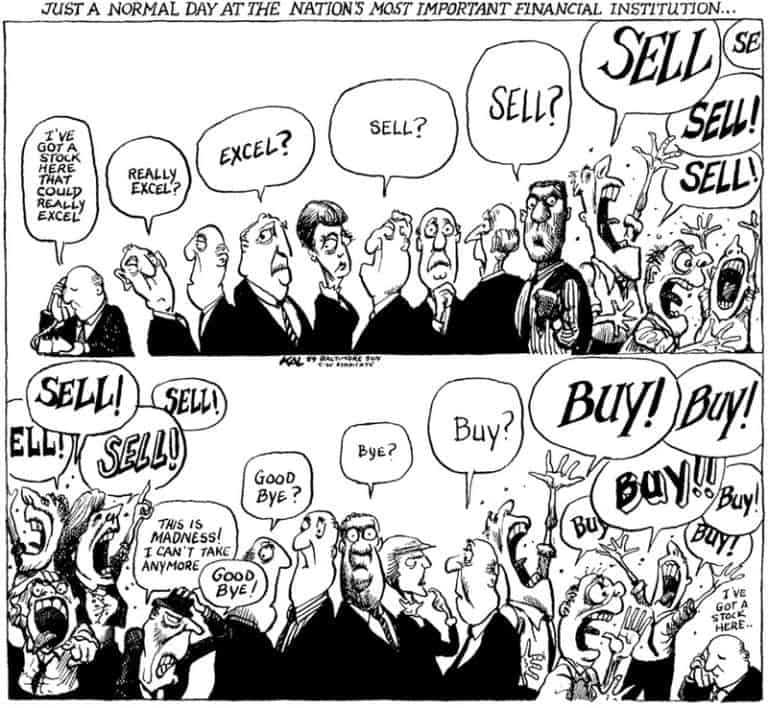
It's the most extraordinary bubble burst ever since the end of the 1920's and it might even take a few more years before we start feeling the angst to the full; for we should remember that the heart of the great depression was 1934 and not 1929. Yet, despite the incessant stream of gloom and voicing of bad news - which is reminiscent of Kal's excellent frontpage for the Economist dated November 1997, i.e. the midst of the previous global meltdown in Asia - there is no guarantee that history will repeat itself. Thank God for that. ICT expert Stewart Baines from London even goes one step further suggesting that certain sectors - and the telecom sector in particular - is bound to benefit from the crash.

Marketing lessons can be withdrawn from many events taking place outside of…
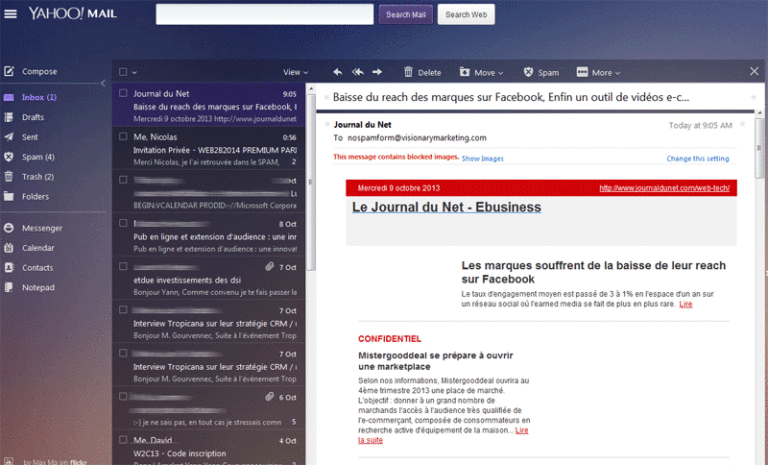
Two days ago, when opening my browser, the homepage of
which is my Yahoo! mail box, I got a message warning me that I had been granted
top user status. The reward was to follow.
I have had a Yahoo! mailbox since times immemorial. More than 10 years for sure. Now I understand why so-called "digital natives" are said to hate e-mail. It is a generational issue. We sort of grew up with it in our professional lives. Youngsters on the contrary favour instant and text messaging; to them e-mail is what is being used to to send messages to your friends' parents.

Webconferencing ROI is very much at the centre of most discussions at…

When I first heard of the release of Google Chrome I thought…

Google is big. And getting bigger. In the online advertising world they have now become unavoidable and so far they suffer no rivalry. They are also projecting to take over rival firm doubleclick but the merger is still under investigation. Grossman's point in this article is that Google obviously has all the means to massage piles of data about users and usage patterns and even do evil things with them but that Google doesn't have an obvious vested interest in using this data in the wrong way, or rather that it has yet to be proven that it has.